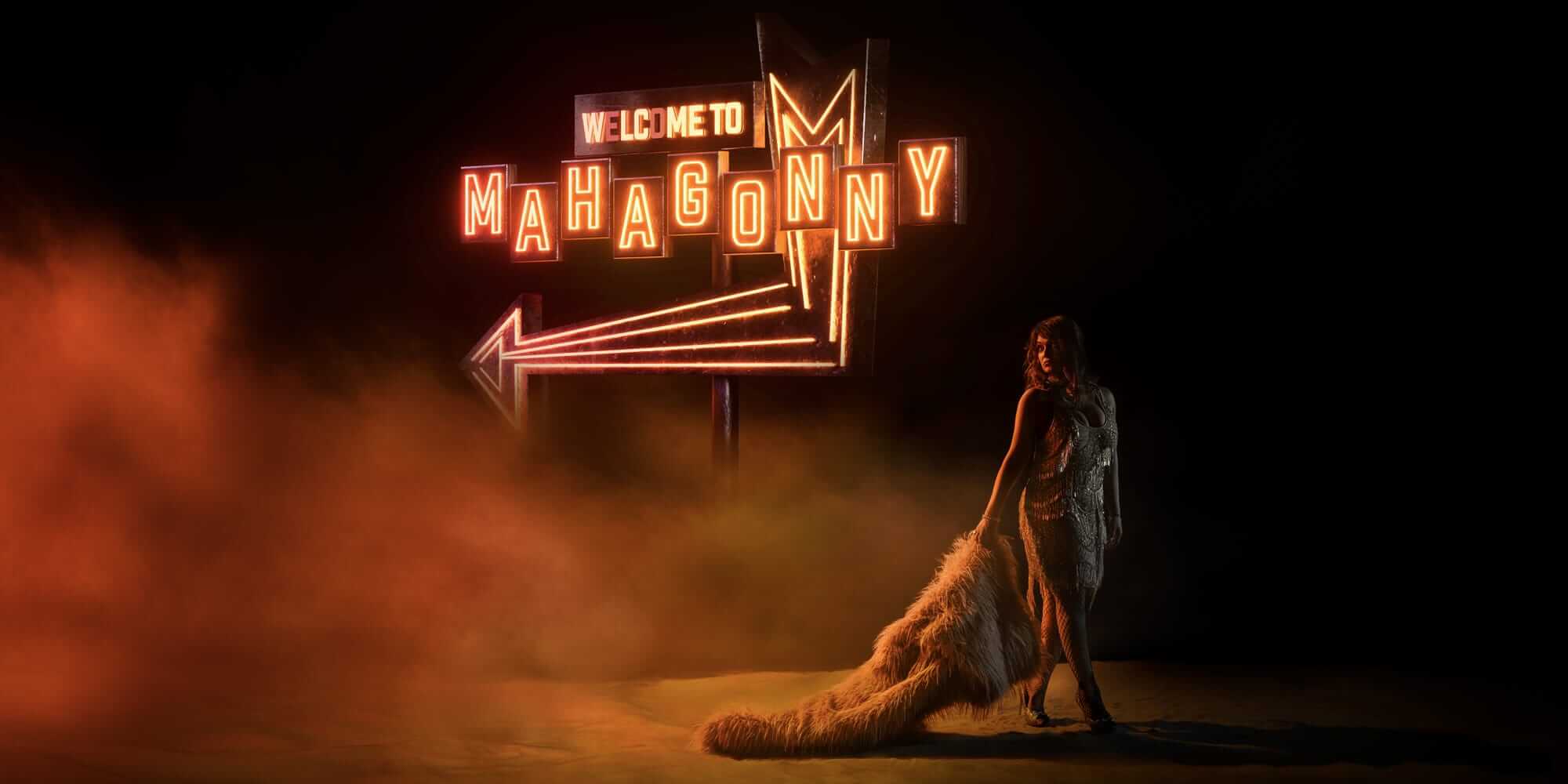
On 16 February 2026, English National Opera premiered a new staging of Rise and Fall of the City of Mahagonny. Directed by Jamie Manton and conducted by ENO’s Music Director Designate André de Ridder, the production played to a sold-out London Coliseum and was met with an overwhelming press response. Collected below are quotes extracted from the two dozen reviews published within the first 48 hours of the opening.
(All photos by Tristram Kenton)
★★★★★
“An exhilarating production, as raw and volatile as surely the creators of Rise and Fall of the City of Mahagonny intended.”
The Times – Neil Fisher
★★★★★
“Mahagonny makes you think and reflect on how little has changed in a century and is as uncomfortable a watch today as it must have been in 1930. A must see.”
Plays To See – Marc Berman
“Jamie Manton directs Rise and Fall of the City of Mahagonny with a creative collision of Brechtian ideas. He employs Brecht’s didactic techniques, curates the chorus convincingly, and makes full use of both the large stage and the theatre’s unique spaces, as well as the sizable cast.”
Theatre Weekly – Pely Carney
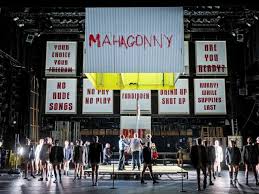
★★★★☆
“Kurt Weill is well-known for his fusion of musical styles, and many of his compositions are still being covered by popular musicians. In Rise and Fall of the City of Mahagonny, he mixes up the standard orchestral opera style with the more unconventional sounds that were prevalent in 1920s American music. Playwright Bertolt Brecht took the ideas of Weill, as well as Elisabeth Hauptmann and Caspar Neher, to shape his disturbing libretto in German. Now helpfully translated by Jeremy Sams into English, the powerful and chaotic melodies of Weill lock horns with those unsettling and impactful words initially created by Brecht.”
The Recs
★★★★☆
“Conductor André de Ridder’s characterization of Weill’s musical styles pays dividends, with powerful, sharply etched playing… In the end, this troubling piece manages to be both repulsive and attractive, and even the bleakness of the final choral tableau has an oddly cathartic effect.”
The Telegraph – Nicholas Kenyon
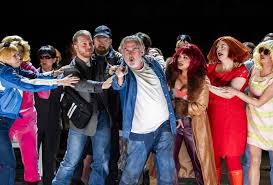
“Mahagonny needs a tireless heroic tenor as rebel protagonist Jimmy MacIntyre. ENO has got the tenor, luxury casting in the shape of top Wagnerian Simon O’Neill… Jon Vickers said he’d never sing the role on stage as the demands were greater than those of Siegfried; this Wagnerian makes it all sound fearlessly easy, and the eve-of-execution solo is the most powerful stretch of the evening.”
The Arts Desk – David Nice
“Brecht’s libretto, rendered into English with real swagger by Jeremy Sams, makes the whole thing feel less like culture and more like an indictment. In 2026, that indictment lands freshly: wealth buys acquittal, poverty earns execution, and a society built entirely on transaction destroys what is most human. Brecht was writing satire. Jamie Manton’s production suggests we’ve been living it.”
Scenemag – Eric Page
★★★★★
“Conducting early Weill requires much ancillary work: particularly in a barn like the London Coliseum, choosing the size of orchestra and chorus and balancing these with solo voices and amplified instruments like banjo and Hawaiian guitar cannot be an easy task, but ENO’s designated Music Director, André de Ridder, managed it with aplomb. De Ridder and the orchestra deftly carried us between saxophone-powered sleaze, string-driven power, guitar-backed schmaltz, the sarcastic bite of the ska rhythms and, yes, standard operatic fare.”
Bachtrack – David Karlin
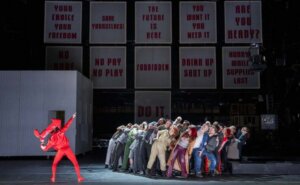
“There is real genius in both the original work and this ENO staging. Director Jamie Manton refuses to treat Rise And Fall as a museum piece about Weimar decadence. Instead, he digs deep to make it feel like tomorrow’s headlines. In the end, it is less an opera than an economic forecast set to syncopation. It argues that, wherever pleasure becomes policy and Mammon is the mayor, collapse is not a tragedy. It is a business model. This is an important and relevant production that reaches beyond the Twenties into our modern hearts of darkness.”
1883 Magazine – Franco Milazzo
“The tension and indeed contradiction between Brecht and Weill will, should always lie at the heart of this work and its performance. Can, should music do what Brecht seems to imply it should? Where does that leave the songs, the tunes, the band? … It can be all too easy hearing Weill in the twenty-first century to succumb to nostalgia for a ‘Weimar’ that never was. Here, edge was maintained without entirely denying us pleasure; banjo and Hawaiian guitar could be heard amidst ominous, bass-led hemming in.”
Seen and Heard International – Mark Berry
“We owe it to Weill—thoroughly steeped in the German classical tradition, which he would subvert in this piece and others—that the score registers, and with a heavy dose of irony involved, contains at least some humanity.”
The Stage – George Hall
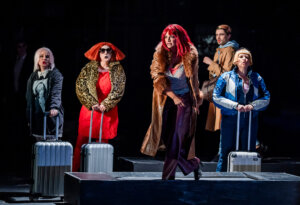
“Danielle de Niese, who plays the prostitute Jenny Smith, is highly engaging throughout the evening and reveals enormous versatility. The sweeter sound that she reveals in ‘Moon of Alabama’ contrasts markedly with her later cries of ‘No, said the men of Mahagonny,’ when the anguish in her voice only emphasizes the unrelenting nature of the horror we see before our eyes.”
Opera Online – Sam Smith
★★★★☆
“The opera can be read as a prescient warning about what was coming in 1930s Germany. As we look at the world today, that should send a shiver down our backs.”
Financial Times – Richard Fairman
★★★★☆
“Beginning with the cracking military drum rolls that signal the dark events to come, the orchestra tells the story. On the turn of a sixpence, they transform into a jazz band, a French café band and a full-blooded romantic orchestra, all with remarkable authenticity. André de Ridder keeps the pace flying, and the music builds to a frenetic and exciting climax.”
Musical Theatre Review – Effie Gray
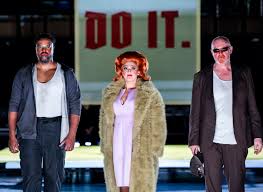
“A deliciously larger-than-life trio of wrong’uns – Kenneth Kellogg’s Trinity Moses, Mark le Brocq’s Fatty the Bookkeeper and Rosie Aldridge as Leokadja Begbick – sets the tone for a Mahagonny that’s all Vegas-promises and Blackpool reality. Kellogg’s scowling lower register creates plenty of friction with Le Brocq’s blindingly-bright, New Jersey-accented tenor, while Aldridge commands the stage – an absolutely towering performance as the bitter grande dame, whose pronouncements carry the death penalty, and whose capacious mezzo can bark or croon or soar.”
Opera Now – Alexandra Coghlan
★★★★☆
“Mahagonny first reached the stage in Berlin in 1930, and you might say that the feeling in the world now is not so very different, but Manton doesn’t give us obvious parallels or references to Trump and Vance. The joke is more on us. Those sucker tourists, initially in office wear, making their first appearance like extra audience members, lined up in the aisles and stood in the boxes.”
The Guardian – Erica Jeal
“There’s no denying that Rise and Fall of the City of Mahagonny packs a punch. Kurt Weill’s score has bite, color and a kind of glittering vulgarity that can turn on a threepenny bit from cabaret to catastrophe.”
musicOMH – Keith McDonnell
★★★★☆
“A Trumpian ‘hellhole’ opera… The whole scenario could scarcely be more alarmingly relevant to our time.”
The Standard – Barry Millington